Sunday, July 14, 2013

Aaaagh. The Internet.

Freiburg is a wonderful city, and great bike trails and bike lanes on roads (or roads labeled as primarily for bicyclists - I think - Fahrradenweg), and intersections labeled with suggested bicycle routes to towns and cities.

But, although we're in a fancy hotel, and paying a lot for internet, can't sign in easily and when I do sign in had to wait for about 15 minutes to load Strava home page, but then couldn't stay connected long enough to load my ride file.  So, this is over a very expensive cellular data link - and therefore very, very short.  And, haven't had a chance to load any of the stuff I've written in the past 4 days - poor internet connections at campgrounds.

no photos - they're on the laptop and I can't load them onto ipad.

So, not much from here.  Will try again later.

Internet was definitely better in China, but the German food is better in Germany.

Watching Mount Ventoux in German - can't understand much except when I heard "Peter Sagan" and "wheelie" in the same sentence.  (Froome just rode away from Contador - "unglaublich"!)

Riding from France into Germany, funny little things that get noticed:  very organized Germans all ride single file on the  bike paths - French formed armadas that wobbled all over the place.

In France, hard to find your way on the bike paths - in Germany, so well labeled and laid out, hard to get lost.  Architecture in France was ornate, beautiful, dramatic - in Germany, pretty, neat, well-tended.  Interesting change of cultures in a short way.

More later if I ever get decent internet.

Thursday, July 11, 2013

Into the hills

After a few days of riding through relatively flat to barely rolling, with big fields of grain, beets, and vineyards and towns with big gothic cathedrals, the terrain has changed.  More forests interspersed with smaller fields - mostly growing hay, some alfalfa for the cattle.  Lots of cattle (Carolais - look like Palomino horses, or maybe somebody had a terrible accident with a bottle of bleach).  Small farms, very small villages.

Into the Vosges Mountains - rather gradual climbs, but in steep sided valleys.  The Vosges are formed as the western side of the Rhine plain.   The Rhine (for the geology bluffs) Valley here is a graben - a flat plain about 50 km (30 miles) wide with geologic faults on either side - pretty steep walls to the valley.  But, the slope down away from the valley is pretty gradual, and that's what we're climbing.  Tomorrow we'll finish the climb to the top, then drop down into the flat Rhine valley and 2 days from now ride across the flat valley.

Riding today was through small farms and higher up the valley through beautiful, dark, shaded mixed conifer and deciduous forests - reminiscent of areas of New England, or of Oregon coastal range - but with smaller trees.

We'll ride into Munster - a French town, not the better known German town which is far to the north. Munster cheese is named for the French town, not (as I had long thought) for the German city.

The Vosges Mountains are in the area of Alsace-Lorraine.  It is an area where towns that spoke German were intermingled with French-speaking towns.  In 1870, the Germans won a war and took over Alsace-Lorraine and kicked out as many French as the could.  In 1918, the French took it back - guess what they did.  In WWII, Hitler used Alsace-Lorraine as an example of the evil of the French - and used that as a way to whip up a little militaristic fervor  (seems to have succeeded).  Germany never annexed the area, though the controlled it during most of WWII, and now it's back to French - though we're seeing more and more German sounding towns, and German names on streets (and one of our fellow riders poinnted out, at our campground German style unisex bathrooms and shower rooms  - doors on the showers, much to the girls' delight).

Yesterday was supposed to be the longest day of the tour - 130 km.  I managed to get lost with a group in the morning and added an extra 25 km, then get lost with Jean in the afternoon and added another  10 km or so - managed to get in a nice century ride.

Sorry, unable to load any new pictures today.


Tuesday, July 9, 2013

The dark, doping underbelly of music

Ate lunch with some musicians and (being cyclists) had to talk about doping.  Learned about the dark underside of the music world - beta blockers to prevent stage fright among musicians.  Learned that it was most prevalent among wind players - if they make a mistake it stands out far more than among string players who can hide in amongst all those other violinists.

But, turns out that the most common performance "enhancer" is not beta blockers (propranolol), but good old alcohol - despite all the problems of potential for taking a bit too much and making a royal ass of yourself.

Police on rollerblades at the Louvre!  Sweet.  I wonder if they play roller blade hockey among the statuary, after the crowds go home in the evening.

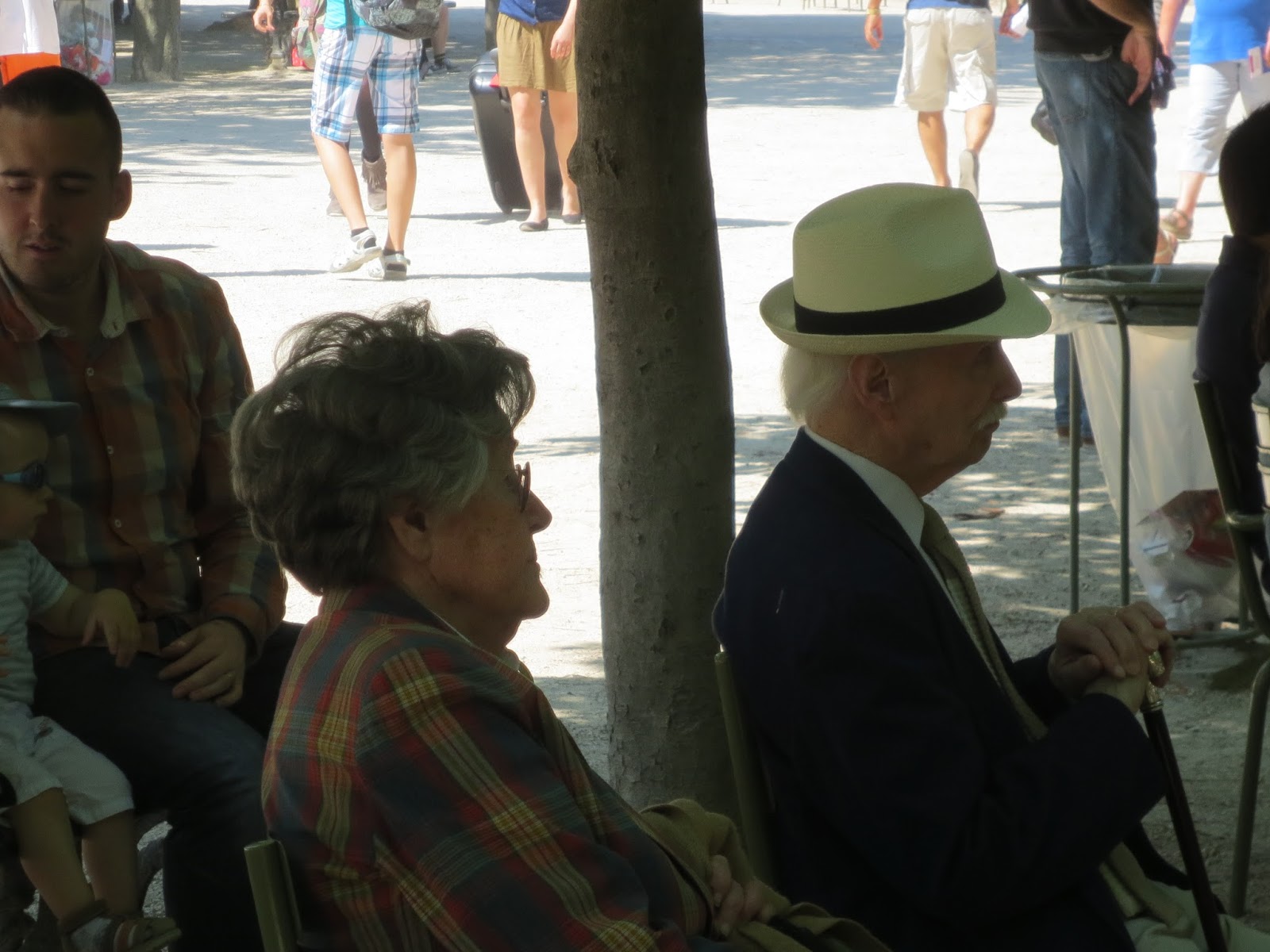
A stroll around the Luxembourg Gardens was great for flowers, outdoor sculpture, and people watching (and surreptitious photography):


Out of Paris

2 days ago we "convoyed" out of Paris - quite a challenge taking 25 people and keeping them together through the twists and turns and traffic lights of Paris (and the broken glass - 2 flats just getting out of town).  Then on through some very uninteresting suburbs and on to a campsite at Chenoise.  A small enough town that the only thing that Wikipedia has to say about it is that it's "inhabitants are called Chenoisiens."

OK - 'nuff said.

Rode yesterday through the town Provins - it has an old medieval (as opposed to a young medieval??) walled city, moats, drawbridges and towers.  And, people still living in the old houses - including a woman sitting in her open window smoking.  How very French.

The big church in town was started in the 1100's but by 1400 only had the front half finished, so they just bricked over the big arches, put in a door and called it good.  I wonder if the contractor had any late completion penalties to pay.

In the category of looking for stuff we don't see at home:  there are signs - especially in the cities that basically lay out "hand-holding" zones for little kids - a blue sign with an adult and child walking along without hands held denotes areas where there aren't traffic or other objective dangers.  The same sign with a red diagonal line through it denotes the areas where holding your kid's hand is a good idea.

Riding yesterday was through pretty flat terrain - I guess you could call it rolling, but the rollers were nothing like we think of - just barely perceptible rises and fall in the terrain.  Though, I accumulated 500 or so meters of climbing during the day, it would be hard to tell where the vertical gain came from.

Fields of wheat, barley, corn, sunflowers (flowers not out yet), sugar beets, and hemp (no Maui Zowie that I could see - all grown for textile fiber.  Such a waste).

Today was a rest day, so I did what I usually do on a day off and went for a ride and found CHAMPAGNE.  We're in the Champagne-Ardennes region, but hadn't found any vineyards yesterday.  On today's ride, I found a ridge of low hills (500 foot climb up to the high point, and on all the southerly facing slopes were vineyards - including on remarkably steep slopes with machines that looked like big bugs going up and down over the vines on slopes that were steep enough that they'd be good blue slopes at a Colorado ski resort.  I was really surprised that the machinery could be used on something that steep - especially since the machines have to be quite high to fit over the vines, and yet pretty short wheelbases to make the sharp turns at the end of the rows.  The machines look like something out of a bad science fiction movie.


The local cathedral here in Troyes (pronounced TWAH - not sure how you get there) is dedicated to some saint who got tortured by the world's largest nipple clips.


I presume that by the end of this tour you'll be tired of seeing pictures of us riding through narrow winding streets with old buildings, often tilting precariously, and large old chateaus and churches in various states of disrepair.  Here's today's batch:


We see lots of old buildings (one in Troyes from the 900's) with "Normandy style" or "half-timbered" style construction.  I found a wall that was partly deteriorated so that you can see what's inside the wall.
If you just made a square out of wood, it would be easily deformed from 90 degree angles - but, if you add a diagonal timber, it's harder to knock it out of alignment (last time I helped build Habitat for Humanity houses, we did the same thing but used a steel angle iron as the diagonal - slotted into grooves cut into the 2x4's of the main framing).  Then, between the parallel upright timbers are short crosspieces that are cut a bit longer than the space into which they fit - so that they can be wedged into place - presumably with no nails to hold them in position.  Then, fill all the spaces with mud and you have a Normandy style home that you would pay extra for the decorations in an American Suburb.


Housing prices:  Looks like a fairly run-of-the-mill small house - 100 square meters = 900 square feet for about 700,000 Euros - roughly $800,000 at current rates.  Wow.

More later on Gothic construction techniques.

Saturday, July 6, 2013

Emergency Medicine Rouen

Got to visit the ER at Rouen with Nicholas - a few random observations.

340 patients per day average (recently had 489 in 24 hours!  Yow!).  Plus another 40,000 per year at pediatrics next door, and 15,000 per year at the OB/GYN hospital a block away (If seen at OB/GYN and turns out not to be gyn - after the pelvic done - they're transferred by ambulance over to the main ER.)  And a separate ophthalmology ER - not sure how many they see.  (I recall from Nepal, that Nico was surprised that we had some ophthalmology skills - like using a direct ophthalmoscope - that weren't part of general medicine in France).  3000 inpatient beds.  In summary:  BIG!

Oh, I forgot - there's also a 22 bed observation unit staffed by 2 ER MD's.  Keep in OBS up to 48 hours.

The main ER has 5 attendings and 9 residents during the day, and 3 attendings and 5 residents at night - 10 hour shifts. If you do the math, the throughput is pretty high.  The attendings tend to see the sickest patients with a resident, and to turn the crank on the least complex to keep things moving.  The residents see those in between with no online attending oversight.  YOYO.

The main ER is 69 beds plus a number of triage beds, and sometimes hallway beds (which are counted as inpatient beds for billing purposes - you move to a hallway bed to be "admitted".  Proves that the US doesn't have a monopoly on stupid accounting procedures in medicine.)

Like University Hospital, on the electronic tracking board a red "stop" sign appears when a patient has been in the ER long enough that a disposition should be considered.  But in Rouen it's at 6 hours, rather than at 2 hours.  That must mean something, but I'm not sure what.

A quick scan down the board shows a preponderance of 2-3-4 hour length of stay.

A casual glance around shows differences in the physical space:  most beds don't have monitors, no beds have TV's to keep the patients amazed and amused, the whole space looks old and not very bright and cheery by US standards.  There's not much privacy for patients - get to say "Bonjour" to everyone as you walk by.  Far less in the way of creature comforts (though they do have pillows).  Less technology - paper charts instead of electronic, x-rays on film rather than digital, and only one old ultrasound machine.

Those working at University will appreciate:  small rooms, cramped spaces generate a lot of sound damping.  It's quiet!  You can hear people talk in a normal voice without listening in on other conversations, and being assaulted by bells, and sirens from all over the giant hangar!  Nice.

All the staff wear white - nurses, Docs, everyone that I saw.  None of the hierarchy of colored scrubs.  (Sadly, no nursing caps.)

The CT scanner does about 55 studies per day - 2/3 for the ER - the rest for ICU.  That seems to be about 10% of patients get scanned, a bit less than half of the percentage that we scan.

The ED does a patient satisfaction survey every 3 years (!) and reports 91% favorable rating (take that Press-Ganey).

The most interesting difference:  the communication centers.  The European version of 911 is 112.  Calls come in to a center where they get triaged to police, fire, medical.  Medical is then picked up by a technician and in some cases turned over to a Doctor who staffs the call center - 2 in the day, one at night.  The doctor can give advice, send a transport only basic rig, or send a rapid response car including a doctor and nurse along with the transport ambulance (the doctor and nurse also staff inter-hospital critical care transfers).  The doc/nurse combo then stabilizes and hops in the transport rig for the trip to hospital.  There is also a PCP communication center !!!!! whose doctor can give advice, ask for EMS help, or arrange a same day clinic appointment at the nearest available clinic.  That seems just too reasonable to work in the US.  Well, maybe Kaiser.

There's a backup disaster comm center - staffed full time during the million visitors for the "tall ships" gathering a couple weeks ago.

I've noticed that in Paris, for a large city, there are relatively few ambulance sirens - I'm guessing that if an MD triages the call, then most ambulance transports are not lights and sirens to the scene which should cut down sirens by 90% or more compared to the US system of all EMS calls get a lights/sirens response and then most get a routine trip to the hospital since most EMS calls aren't time critical emergencies.  Way cool, and nice for the auditory environment.

I only spent an hour or so at the ER, and saw so much of interest, I need to go back sometime and spend a few days just following cases through to see how the system functions.

It seemed in a very brief run through to be much more oriented to functionality, and less to high tech, less to hardware, and less to creature comforts.  Wonder how much is choice, social expectations, and how much is flat out budgetary constraint.

Gotta come back some day.  Nicholas:  thanks for the tour!  I'm kinda hoping to have a nice bike crash while I'm here - to test the system personally.  (Not!)

Help! We lost the "R"!

We were called and asked to help solve a mystery:  Where did the "R" in go in Rouen.  They lost it many years ago and have been forced to call the city "Hoo-Awn" - ever since.  We looked, and looked, and still - no sign of the "R".  The unfortunate people of France will still be forced to pronounce the name of the place:  "Hoo-Awn."  I'm so sorry.   (The problem is widespread, as Patrick  Roy (Wah), new coach of the Colorado Avs, will tell you.)

Nicholas Peschanski is a friend with whom we worked in Nepal a few years ago - now an ER Doc in Rouen.  We stayed with him and his wife, Isabelle, overnight and with his 2 kids Lila (6 years) and Thylen (3).  The kids were sooooooo much fun and we had a blast with them, even though we didn't share a language, we played and giggled, and walked around the old town, and perhaps the highlight of the day when they both gave us a kiss goodnight.  It was just amazing too me, how much we could communicate, and how well we could get along without sharing any actual words - although Lila did teach me to count in French.  We learned that Lila, when hearing that English-speaking visitors were coming, had made Isabelle promise to translate everything that we said.  I think Isabelle came pretty close to keeping the promise.

A sidelight, when counting on your fingers here, you start with your thumb being "one", and continuing from there so that "four" is a thumb plus 3 fingers.  If you try to hold up just your index finger, foks get confused.  Such a simple little concept that is different in 2 languages and cultures.

Back to Rouen - it's a good sized city, a million plus people that is the head of deep water navigation on the Seine, and the biggest grain shipping port in Europe.  It was reportedly 45% destroyed in World War II - though most of the destruction was on the left bank where the industry was and much of the old city was spared, though some of the old stone buildings still have scars in the walls, from bullets.

We walked through the beautiful narrow streets with old Normady architectural style - wooden beams running horizontally, vertically, and diagonally with the spaces between beams filled with plaster.  None of the walls are actually vertical - the city is built on swampy gound, and the buildings settle into the ground and with buildings being 500-600 years old, they are quite crooked.

The oldest clock in Europe was recently restored - looks to be about 10 feet square, and has lots of real gold on it.

A recent visit of the "tall ships" - the old sailing ships, brought more than a million visitors to the city.

If you've ever had any sterotypes of French folks carrying around baguettes and eating them, they're true!  As we walked, Isabelle ran into a bakery, bought a big long baguette.  The kids nibbled on the ends, while we tore off pieces of the delicious, still warm bread, and nibbled our way down the streets.  Looking at displays of photographic art mounted along the walkways.  (By the way, even more stereotypical, while walking in Paris, there really were guys standing on the bridges and playing  the accordion - songs that made you want to cry, and that could have been from a Goddard movie from the 60's.)


A few sights I'm not used to:  violin repair shops.

Tuesday, July 2, 2013

Paris! Is like, well, Paris.

It's really strange.  Paris is like all the caricatures that I've ever seen.  There are guys on the bridges playing accordion music that makes me want to cry and sound like it's out a 1950's movie - ? Goddard, "A Man and a Woman", stuff like that.  There are cafes everywhere - especially on the left bank - I keep expecting to see Communists or existentialists or philosophers.  Wine is cheaper than water - at dinner tonight a small bottle of Evian was 3.70, but a glass of Reisling was 3.60.  Most of the other white wines by the glass were 4.20, but a glass of coke was 4.30 - no wonder there are so many painters here (though, now that I think about it I haven't seen any painters yet - I guess that's pretty un-Parisien).

Our hotel is on a canal and in the evening there are numerous little groups (10-15) sitting and partying around large numbers of wine bottles.  The more active ones are playing bocce or something like it, but on hard packed, bumpy dirt - seems to make it so the intoxication is less noticeable since the roll of the balls is totally unpredictable anyway.

Evening is an inclusive term - we're far enough north that it's still pretty light out at 11:15  (48 deg north latitude compared to 42 in Boston and 40 in Boulder).


Trip over was frighteningly uneventful - check-in took about 38 seconds, the flight was straightforward (though I didn't sleep well), the bags and bikes all arrived in Paris with us - and undamaged as best I can tell (though I haven't built Jean's bike yet).  The gods may be saving the worst for later.


The most interesting sight on the way over was a little girl - 4 or 5 years old - who was blind, and running around in the airport, with her seeing eye cane with a plastic ball on the end so that it slid along more easily, running, fast, unconcerned about consequences, with Mom looking on and occasionally trying to get some sort of control - but, appearing to realize that she was beaten and there was no hope.  The kid seemed to take great pleasure in running on the moving walkways and trying to guess, with the help of the cane, when she was going to hit the end of the moving belt and trying to keep her balance as she blasted onto the not moving floor.  Never saw her fall doing it, but the gyrations were interesting, and the look of alarm on Mom's face was even more interesting.

There's a lot of people here (12 million at a per mile density about 5 times as high as NYC - 54,000 per square mile), plus 40 million tourists per year.  Jean and I have been playing a game:  spot someone on the street and try to guess what language will come out of his or her mouth.  I'm lucky if I guess right 40% of the time.  Although, often some of the real classic Parisien types actually do speak French and appear to be locals.  (It was rather bizarre to have one of the classic French accordion players looking the part except for the NYC baseball cap.)

The Eiffel Tower really is pretty cool, in a strange sort of way.  There's a restaurant there where dinner starts at 220 Euros (about $250 USD).  Jean and I didn't check out the menu - went looking for somewhere with more character.  The lines were so long that we didn't think of going up into the tower.

Went for a short ride today.  Bike path along a canal.  Canals are really, really flat.  I haven't done anything that flat ever before (well,bowling) only altitude change was a couple pedestrian bridges back and forth over the canal.  Pretty urban ride - walkers, baby strollers, skateboards, slow - never been on a bike before - wobbling riders, commuters with hi vis vests lights bells horns, and faster riders weaving in and out among each other.  Multi colored, multi racial, multi lingual - quite a few languages that I didn't recognize (Canadian?  and maybe others).  Did I mention, flat!

No pictures yet, I could write for days and we haven't started yet.

Later.